Akki Yadav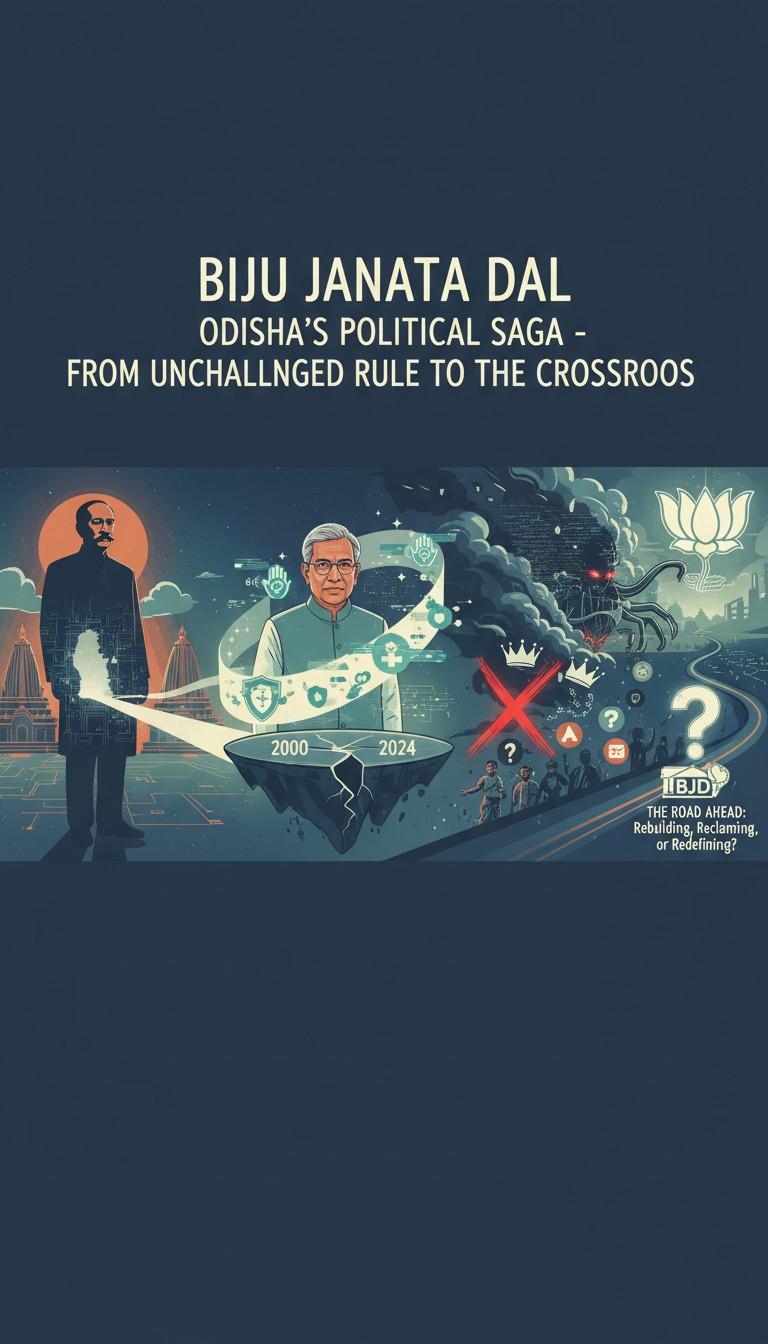
Introduction: The BJD Phenomenon – A Brief Hello to Odisha’s Political Giant
Ever heard of a party ruling a state for nearly a quarter-century? In the intricate tapestry of Indian politics, the Biju Janata Dal (BJD) emerges as a striking thread. Born from the soil of Odisha and rooted in the towering legacy of Biju Patnaik, this regional powerhouse has long championed the state’s unique identity and the aspirations of its people. But what lies beneath the surface of this political behemoth? This is a story of legacy, power, alleged misdeeds, and a stunning reversal of fortune – a deep dive into the BJD’s journey, inextricably linked with the man who led it for so long.
The Legacy Lives On: How the BJD Came to Be
The genesis of the BJD is interwoven with the life and times of one man: Bijayananda (Biju) Patnaik. A charismatic figure and two-time Chief Minister, Biju Babu, as he was affectionately known, cast a long shadow. His legacy of regional pride and development initiatives served as the fertile ground for a new political entity.
On December 26, 1997, Naveen Patnaik, Biju’s son, stepped onto the political stage, birthing the BJD from the remnants of the Janata Dal. This wasn’t merely a change of name; it was a strategic move born out of internal squabbles and a perceived vacuum in Odisha’s non-Congress politics. More importantly, it was a conscious effort to carry forward Biju Babu’s vision. Partnering with the BJP’s NDA in its early days, the BJD aimed to challenge the Congress party’s long-standing dominance, a calculated gamble that paid off handsomely.
The alliance proved potent, dislodging Congress from power in 2000 and ushering in the Naveen Patnaik era, a period that would redefine Odisha’s political landscape.
The Naveen Patnaik Era: A Quarter Century of “Patnaikism”
From 2000 to 2024, Naveen Patnaik’s leadership became synonymous with Odisha’s governance. It was an era marked by stability, welfare initiatives, and a distinct political ideology often referred to as “Patnaikism.” This philosophy blended social democracy, Odia nationalism, and regional development with a steadfast commitment to secularism, a delicate balancing act in India’s complex socio-political environment.
Flagship schemes like BSKY (healthcare), Mission Shakti (women’s empowerment), and KALIA (farmer support) became deeply ingrained in the public consciousness, lauded for their impact on the lives of ordinary citizens. Yet, the path wasn’t without its twists and turns.
In 2009, the BJD parted ways with the BJP over concerns about communalism and disagreements over seat-sharing, a pivotal moment that underscored the party’s commitment to its secular ideals. Subsequently, the BJD adopted a strategy of maintaining equidistance from both the UPA and NDA at the national level, carefully navigating the political landscape to cement its regional identity and maximize its leverage. This approach proved remarkably successful, leading to sweeping victories in state and local elections and solidifying the party’s dominance well into 2022.
Beneath the Surface: Cracks, Scandals, and Whispers of Discontent
However, even the most seemingly invincible fortresses can develop cracks. As the BJD’s reign continued, accusations of corruption became increasingly persistent, particularly from the BJP, which now occupies the treasury benches. Allegations of “looting public money” swirled around prominent figures, from the infamous Chit Fund Scam to accusations of Adani bribery (strenuously denied by the BJD), and alleged irregularities in government job recruitments. These scandals, whether substantiated or not, chipped away at the party’s image of clean governance.
The rise of V.K. Pandian, a former bureaucrat, as a powerful aide to Naveen Patnaik also became a focal point of controversy. Questions arose: Was he wielding undue influence, acting as a de facto “Super CM”? Did his presence alienate senior leaders and overshadow Naveen Patnaik’s leadership, ultimately contributing to the party’s downfall in 2024?
Furthermore, Naveen Patnaik’s advancing age and health sparked concerns about succession, fueling speculation about who would inherit his mantle. Was Pandian being groomed for the role, potentially sidelining seasoned party veterans?
Even the party’s commitment to secularism faced scrutiny. Instances like the Waqf Bill “split voting” raised eyebrows and fueled whispers of potential backroom deals that could compromise the party’s stated principles. Some critics argued that the BJD had shifted its focus from its traditional pro-poor roots to prioritizing “development” initiatives like temple beautification, potentially losing touch with its core voter base.
The 2024 Earthquake: A Stunned Exit and a New Role
Then came the earthquake of 2024. After 24 years in power, the unthinkable happened: the BJD lost both the Lok Sabha and Assembly elections to the BJP, a seismic shift that reverberated throughout Odisha’s political landscape. The numbers told a stark story: a massive drop in vote share and a dramatic reduction in the number of seats held, transforming the BJD from a dominant force into the opposition.
The aftershocks continued with the Nuapada by-election in November 2025, where the BJD finished a distant third, a further indication of its weakened position. The party cried foul, alleging “large-scale rigging” and “serious discrepancies” in the election data, demanding an independent audit to restore faith in the electoral process.
In a dramatic turn, the BJD transitioned from a party that often supported the Union government to one that now positions itself as an “assertive opposition force” at the national level. The party has adopted a more critical stance towards BJP policies and is actively pushing for greater electoral transparency.
Meanwhile, the new BJP government has wasted no time in rebranding many of the BJD’s iconic welfare programs, a symbolic act that underscores the changing of the guard. Internally, the BJD is grappling with dissent, defections, and calls for a complete organizational restructuring in the wake of its electoral defeat.
The Road Ahead: Rebuilding, Reclaiming, or Redefining?
The BJD now stands at a critical juncture, facing a multitude of challenges that will determine its future trajectory. The leadership question looms large. Naveen Patnaik has made strong statements about his desire for a non-family member from within the party to succeed him, while V.K. Pandian has withdrawn from active politics, leaving a vacuum at the top.
Can the BJD reassess its strategy and reconnect with the electorate beyond its historical welfare politics? The party needs to offer a fresh vision for Odisha’s future that resonates with a changing demographic and addresses the evolving needs of the state.
The rising influence of the BJP in Odisha poses a significant threat to the BJD’s future. The BJP has successfully tapped into a new wave of aspirations and has positioned itself as a viable alternative, forcing the BJD to adapt or risk being marginalized.
The BJD continues to push for “special status” for Odisha and advocate for greater state-specific financial autonomy, highlighting its commitment to regional interests. However, it remains to be seen whether these demands will gain traction in the current political climate.
The coming months will be crucial in determining whether the BJD can navigate its new reality, rebuild its base, and reclaim its stature, or whether a new political order has firmly taken root in Odisha.
Conclusion: What’s Next for Odisha’s BJD?
The BJD’s journey has been nothing short of remarkable, a testament to the power of regional identity, welfare politics, and strong leadership. However, the party now faces unprecedented challenges, from allegations of corruption and internal divisions to the rise of a formidable opposition.
Key questions remain: Who will lead the BJD into the future? What strategies will it employ to reconnect with the electorate? And how will it navigate the complex political landscape of Odisha and India?
The story of the Biju Janata Dal is far from over; it is a compelling political saga that continues to unfold, with the next chapter yet to be written.