Editorial Team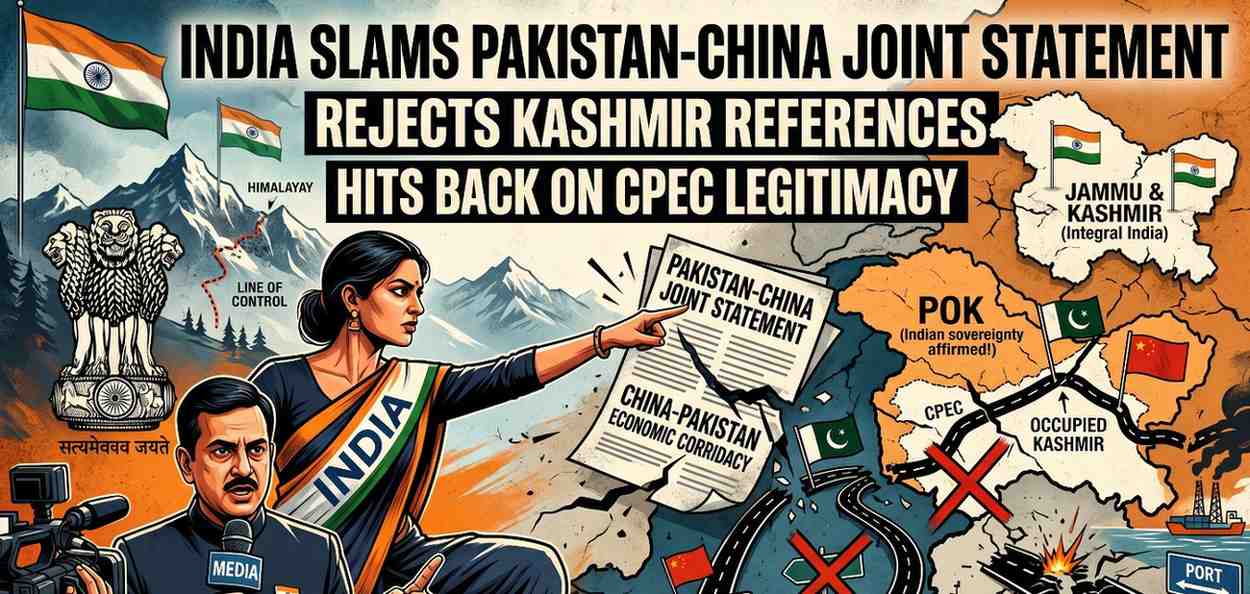
NEW DELHI (ANI) — India has issued a fierce diplomatic pushback following a joint statement released by Pakistan and China, flatly rejecting their commentary on Jammu and Kashmir and strongly opposing ongoing activities under the China-Pakistan Economic Corridor (CPEC).
In a sharply worded response to media queries, Ministry of External Affairs (MEA) spokesperson Randhir Jaiswal stated that New Delhi resolutely opposes any moves by foreign nations to validate Pakistan’s “illegal and forcible occupation” of Indian territories.
The dispute erupted at the conclusion of Pakistani Prime Minister Shehbaz Sharif’s official diplomatic visit to Beijing, where both nations released a comprehensive joint communique touching upon regional security, infrastructure, and territorial disputes.
The Core Points of Contention
The diplomatic friction centers on three major pillars, summarized below:
| Area of Dispute | Joint Statement Position | India’s Diplomatic Counter |
| Jammu & Kashmir | Called for a resolution based on the UN Charter and relevant resolutions. | Reiterated that Jammu, Kashmir, and Ladakh remain “integral and inalienable parts of India.” |
| CPEC Projects | Pledged to accelerate and expand the multi-billion-dollar economic corridor. | Opposed all projects passing through Pakistan-occupied Kashmir (PoK), citing sovereignty violations. |
| Trans-boundary Waters | Hinted at direct cooperation on shared water systems. | Noted that China and Pakistan share no natural border; rivers flow through Indian territory. |
Strict Rejection of Sovereign Violations
Addressing reporters, the MEA spokesperson made it clear that third-party commentary on India’s internal matters holds no legal standing.
“We have noted the references to the Union Territory of Jammu & Kashmir and the so-called China-Pakistan Economic Corridor in the joint statement. The Union Territories of Jammu & Kashmir and Ladakh have been, are and will always remain integral and inalienable parts of India. No other country has the locus standi to comment on the same,” the MEA statement read.
India’s primary grievance with CPEC stems from its geography. The corridor, a flagship project under Beijing’s Belt and Road Initiative (BRI), connects China’s Xinjiang province with Pakistan’s Gwadar port via Gilgit-Baltistan—a region India claims as part of undivided Jammu and Kashmir. New Delhi maintains that building international infrastructure through disputed, occupied territory directly violates its sovereignty and territorial integrity.
The Border and Water Reality Check
India also took a direct jab at the joint statement’s mention of “trans-boundary water resources cooperation.”
Diplomatic officials pointed out a fundamental geographical reality: China and Pakistan do not share a natural physical border. The connection they currently share exists only because of Pakistan’s illegal occupation of PoK and the controversial 1963 boundary agreement, under which Pakistan ceded the Shaksgam Valley to China—an agreement India has never recognized.
Because the headwaters and major river systems pass through Indian territory before reaching the region, New Delhi warned that any attempts to alter status-quo dynamics or introduce external mechanisms regarding these water systems are entirely unacceptable.

 Akki Yadav