Editorial Team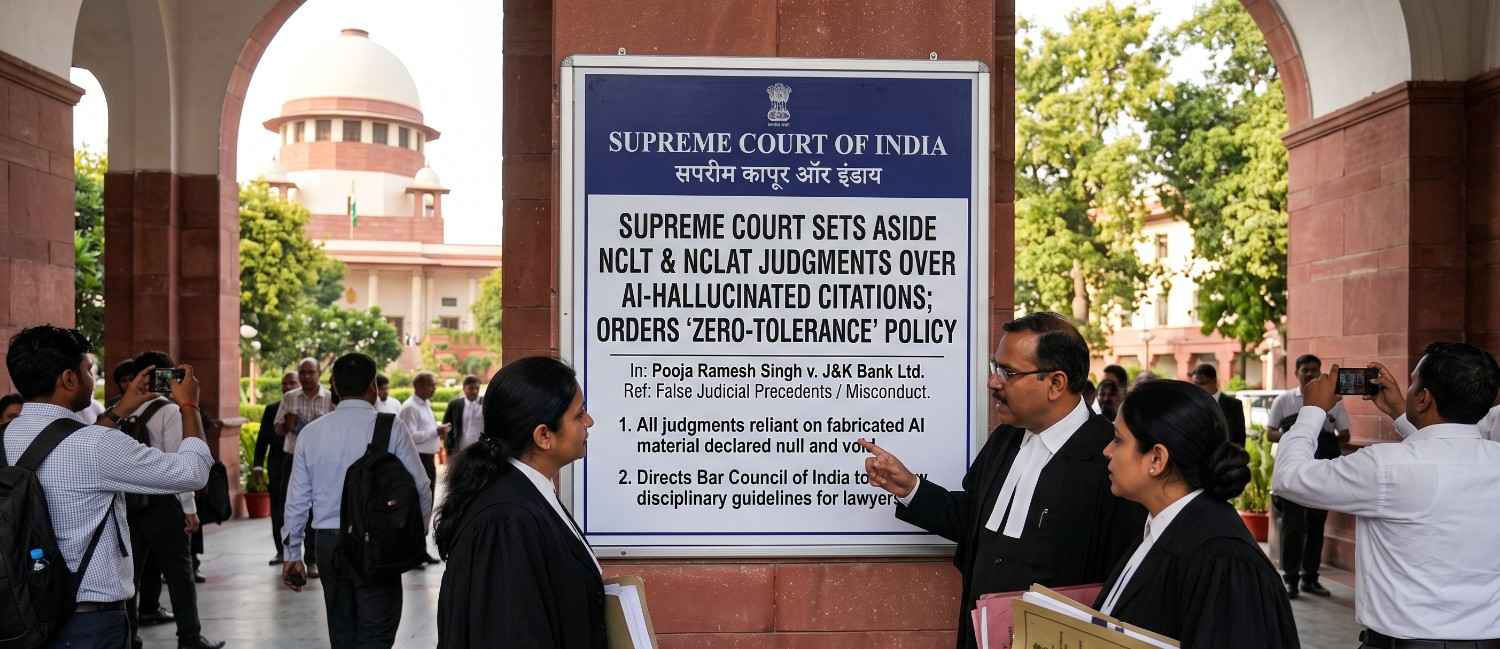
In a landmark decision that will permanently shape the integration of legal technology in India, the Supreme Court of India on Thursday quashed insolvency orders passed by the National Company Law Tribunal (NCLT) and affirmed by the appellate tribunal (NCLAT). The apex court discovered that the initial ruling had relied heavily on completely fabricated, AI-generated judicial precedents.
A Bench comprising Justices P.S. Narasimha and Alok Aradhe delivered a stinging critique of unregulated artificial intelligence in the judiciary, comparing AI hallucinations to a toxic leak.
“For us, that is, for those who are in the province of adjudication and determination of disputes, this by-product of AI, that is the production of fake, non-existing and hallucinated material and its utilization as precedence in law, is like the release of methyl isocyanide in the province of law and justice,” the Bench observed.
The Case Background
The matter arose from an insolvency dispute (Pooja Ramesh Singh v. Jammu and Kashmir Bank Ltd. & Anr.). The appellant, a suspended director of Essel Infraprojects Ltd., challenged a Section 7 insolvency application under the Insolvency and Bankruptcy Code (IBC) that had been admitted by the NCLT Mumbai Bench regarding a claimed debt of ₹87.43 crore.
When the case reached the Supreme Court, Senior Advocate Madhavi Divan pointed out that several foundational “precedents” cited in the NCLT’s judgment simply did not exist in any recognized legal database.
Among the ghost citations hallucinated by the system were:
- ICICI Bank Ltd. v. Urban Infrastructure Real Estate Ltd. (2019) 16 SCC 528 (Entirely non-existent).
- Sarbjit Singh v. Union Bank of India (2022) 7 SCC 464 (Entirely non-existent).
- M. Subramaniam v. S. Janaki (2020) 16 SCC 728 (The citation matched a real case, but the specific legal paragraphs quoted in the text were entirely fabricated).
In a surprising turn, Jammu and Kashmir Bank filed an affidavit clarifying that their own legal counsel had never cited these cases. The NCLT appeared to have generated and relied upon these ghost precedents during its own unverified independent research using AI tools.
Key Directives and Rulings by the Apex Court
1. The “Iota” Rule and Nullity of Tainted Judgments
The Supreme Court declared that any judicial decision founded on hallucinated material is “no decision in the eyes of law.” Crucially, the Bench established that a judgment will be set aside if even an iota of fake AI material enters the decision-making pipeline, regardless of whether it altered the final outcome.
2. Professional Misconduct for the Bar & Bench
The Court ruled that it is an absolute act of professional misconduct for an advocate to present an AI-generated citation before a court without independent verification. However, it also shifted accountability to the judiciary, calling it an “equally serious lapse” when a judge adopts such material without verifying its authenticity.
3. Human in the Loop
The Bench emphasized that while it does not discourage the assistive use of AI for legal research or administrative efficiency, human reasoning cannot be substituted.
“What is significant for our decision-making is our resolve to adopt artificial intelligence technology in aid of adjudication, while at the same time asserting and declaring total and absolute control over adjudications with a human in the loop at every stage.”
Next Steps: BCI and Remand
The Supreme Court has officially directed the Bar Council of India (BCI) to constitute a specialized expert committee to deliberate on the issue of fake AI materials and draft formal regulatory frameworks for members of the bar.
As for the immediate dispute, the Supreme Court has stripped away the tainted legal reasoning and remanded the matter back to the NCLT Mumbai Bench to be re-evaluated freshly and purely on the factual merits of the case.