Editorial Team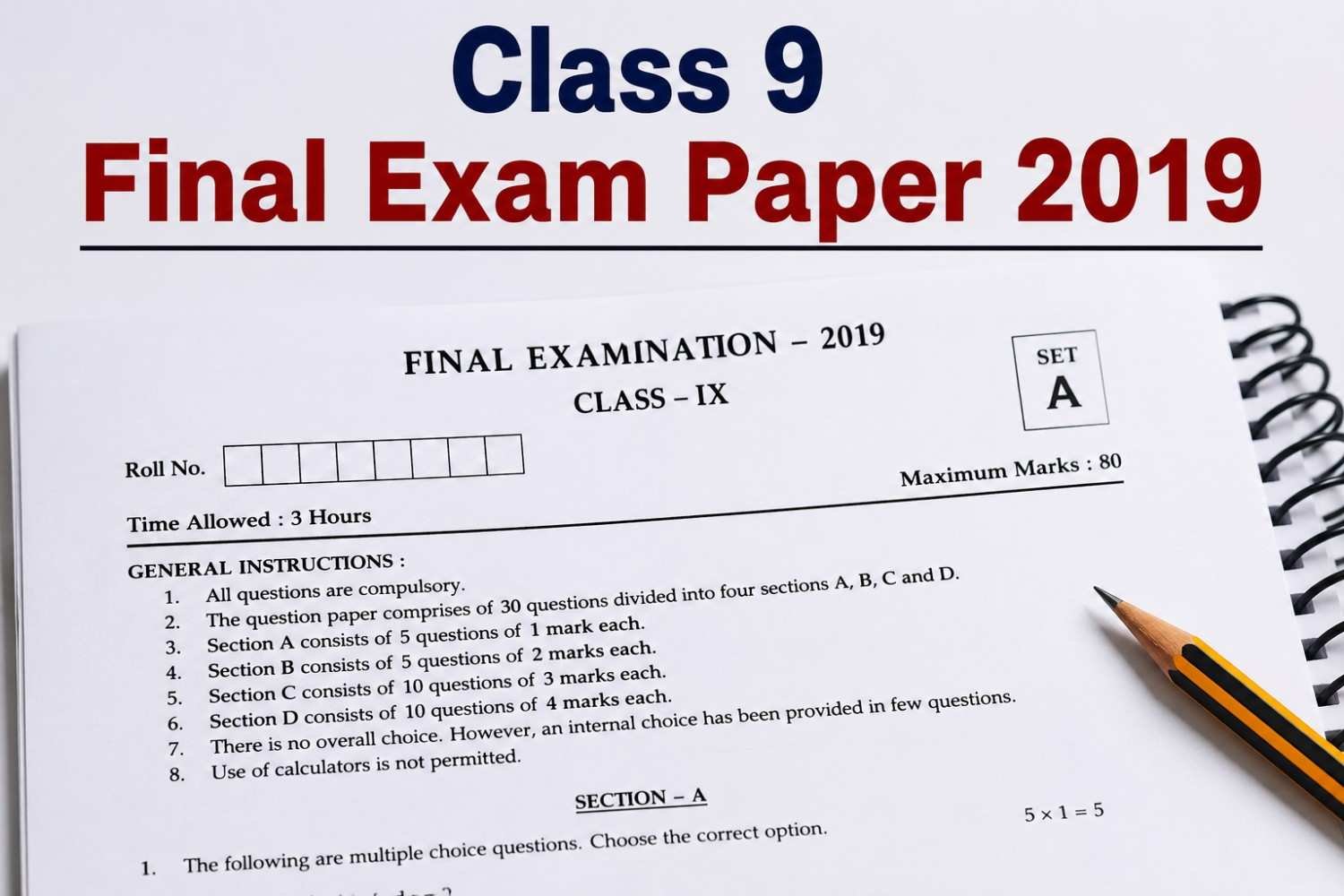
Class 9 Final Exam Paper 2019
Class 9 serves as the foundation for the Class 10 Board Examinations. As annual school assessments approach, practicing previous year papers—particularly the Class 9 final exam paper 2019—remains one of the most reliable methods for students to understand exam formats, time management, and recurring question trends.
Whether you are preparing under BSE Odisha (Board of Secondary Education) or CBSE, reviewing past question papers gives you an edge by identifying high-weightage chapters and common problem types.
Why Solve the 2019 Class 9 Final Examination Paper?
Educational experts and teachers recommend practicing previous years’ papers for four major reasons:
- Real Exam Simulation: Solving the 2019 paper within a 3-hour time block helps build exam stamina and reduces anxiety.
- Understanding Question Trends: Analyzing papers across languages, Mathematics, and Science highlights topics that frequently appear in final exams.
- Identifying Preparation Gaps: Cross-checking answers against model solution keys helps pinpoint weak areas for targeted revision.
- Mastering Objective & Subjective Questions: Practicing both MCQs and long-answer sections ensures well-rounded preparation.
Subject-Wise Key Focus Areas from the 2019 Paper
1. First & Second Languages (Odia / English / Hindi)
- Grammar & Composition: Focus on translation, formal letter/essay writing, and unseen passages.
- Literature: Textual comprehension, short answer questions on prose, and poetry summaries.
2. Mathematics
The 2019 annual exam paper emphasized foundational algebra and geometric proofs:
- Algebra & Number Systems: Real numbers, polynomial factorization, linear equations in two variables.
- Geometry: Triangles, parallelograms, circles, and geometric constructions.
- Mensuration: Surface areas and volumes of 3D solids (cubes, cylinders, cones).
3. Science (Physics, Chemistry, Biology)
- Physics: Equations of motion, gravitation, work, energy, and sound numericals.
- Chemistry: Matter in our surroundings, atomic structure, and chemical formulae.
- Biology: Cell diversity, plant and animal tissues, and improvement in food resources.
4. Social Science (History, Geography, Political Science, Economics)
- History event chronologies, map-pointing exercises, constitutional design, and economic concepts like food security and poverty indicators.
Standard Question Paper Pattern (80 Marks)
| Section | Question Type | Number of Questions | Marks per Question | Total Weightage |
| Section A | Objective / Multiple Choice (MCQs) | 20 | 1 Mark | 20 Marks |
| Section B | Very Short Answer Questions | 6–8 | 2 Marks | 12–16 Marks |
| Section C | Short Answer Questions | 8–10 | 3 Marks | 24–30 Marks |
| Section D | Long Answer / Analytical Questions | 4–5 | 4 / 5 Marks | 20 Marks |
Step-by-Step Revision Strategy for Class 9 Students
1.Simulate Exam Conditions:Environment Setup.
Set up a quiet study room, set a 3-hour timer, and attempt the 2019 question paper without referring to textbooks.
2.Self-Assessment & Grading:Scoring.
Evaluate your responses using standard answer keys or textbook solutions to check accuracy and step-marking details.
3.Revise Weak Chapters:Targeted Practice.
Re-read chapters where errors occurred, solve additional textbook exercises, and create quick summary revision notes.
Note for Readers: For official sample papers, syllabus guidelines, and syllabus updates, always cross-check with your respective board portals (such as bseodisha.ac.in or cbse.gov.in.

 Akki Yadav