Editorial Team
When studying Hindi grammar (Hindi Vyakaran), one of the most fundamental yet confusing topics for students is Varn Viched (वर्ण-विच्छेद). While breaking down simple words is easy, words containing conjunct consonants or complex blends like प्रकाश (Prakash) often trip people up.
In this article, we will look at the exact meaning of “Varn Viched of Prakash,” break it down step-by-step, and explain the grammatical rules behind it so you never make a mistake in your exams or assignments.
What is the Meaning of “Varn Viched”?
Before diving into the word “Prakash,” let’s understand the core concept:
- Varn (वर्ण): The smallest unit of sound in a language (letters/vowels/consonants).
- Viched (विच्छेद): To separate or break apart.
Definition: Varn Viched means separating every single vowel (Swar) and consonant (Vyanjan) sound that makes up a word.
In Hindi, every full consonant inherently has a hidden “ah” ($\text{अ}$) sound attached to it. For example, $\text{क}$ is actually made of $\text{क्} + \text{अ}$. During a Varn Viched, we pull these hidden sounds apart using a halant ($\text{्}$) symbol under the consonants to show they are now soundless.
The Correct Varn Viched of Prakash
Let’s look at the absolute correct breakdown of the word प्रकाश right away.
- In Devnagari Script:$$\text{प्} + \text{र्} + \text{अ} + \text{क्} + \text{आ} + \text{श्} + \text{अ}$$
- In Romanized English Script:P + r + a + k + aa + sh + a
Step-by-Step Breakdown of “Prakash”
The reason why so many people search for the Varn Viched of Prakash online is because of the first syllable: प्र (Pra). It looks like one letter, but it contains a hidden trap.
Let’s break the word down syllable by syllable to see how it works:
1.Breaking down ‘प्र’ (Pra):The Trickiest Part.
When you see प्र, the letter प looks full and the र looks like a small slash at the bottom. However, in Hindi grammar, the rule is reversed! The प is half (silent) and the र is full.
- Formula: $\text{प्} + \text{र्} + \text{अ}$
2.Breaking down ‘का’ (Kaa):The Vowel Sign.
The letter क has a large aa matra ($\text{ा}$) attached to it. When we separate it, we remove the matra and write the full vowel symbol $\text{आ}$.
- Formula: $\text{क्} + \text{आ}$
3.Breaking down ‘श’ (Sha):The Final Sound.
The final letter is a standalone, full consonant श. Since it has no visible matra, it carries the inherent, hidden small $\text{अ}$ sound.
- Formula: $\text{श्} + \text{अ}$
Bringing it all together:
By combining all three steps, we get the complete phonetic decomposition:
$$\text{प्} + \text{र्} + \text{अ} + \text{क्} + \text{आ} + \text{श्} + \text{अ}$$
Quick Summary Table for Students
| Syllable in Prakash | Grammatical Component | Broken Down Sounds |
| प्र | Half P + Full R | $\text{प्} + \text{र्} + \text{अ}$ |
| का | Consonant K + Aa Matra | $\text{क्} + \text{आ}$ |
| श | Consonant Sh + Hidden A | $\text{श्} + \text{अ}$ |
Conclusion
Mastering the Varn Viched of Prakash comes down to understanding how the Padeen Ra (the र at the bottom of प) works. Once you realize that the first letter is half and the blending र carries the vowel sound, solving similar words like Prasad (प्रसाद) or Pratham (प्रथम) becomes incredibly easy!
What is the varn vichchhed of mitra (मित्र)?
The varn vichchhed of मित्र is:
$$म\ + \ ि\ + \ त\ + \ र\ + \ अ$$
मि = $म\ + \ ि$
त्र = $त\ + \ र\ + \ अ$ (Since ‘त्र’ is a conjunct consonant formed by ‘त’ and ‘र’)
The varn vichchhed of त्रिशूल is:
$$त\ + \ र\ + \ ि\ + \ श\ + \ ऊ\ + \ ल\ + \ अ$$
त्रि = $त\ + \ र\ + \ ि$
शू = $श\ + \ ऊ$
ल = $ल\ + \ अ$
How to do varn vichchhed?
Varn vichchhed means breaking down a word into its individual consonants (व्यंजन) and vowels (स्वर). You can do it in 4 simple steps:
Add a Halant (्): Place a halant under every consonant once you separate its vowel sound.
Extract Matras: Replace vowel symbols (matras) with the actual independent vowel letter (e.g., की becomes $क\ + \ ई$).
Add Inherent ‘अ’: Any full consonant without a visible matra automatically has an अ attached to it (e.g., क becomes $क\ + \ अ$).
Break Conjunct Consonants (संयुक्त व्यंजन):
क्ष = $क\ + \ ष\ + \ अ$
त्र = $त\ + \ र\ + \ अ$
ज्ञ = $ज\ + \ ञ\ + \ अ$
श्र = $श\ + \ र\ + \ अ$
How does varn vichchhed relate to grammar?
Varn vichchhed is a core component of Varn Vichar (वर्ण-विचार) in Hindi grammar. It relates to grammar in three key ways:
Foundation for Sandhi (संधि): Word-joining rules rely on identifying the exact ending sound of the first word and the starting sound of the second word.
Pronunciation & Spelling Accuracy: It helps distinguish subtle phonetic differences (such as $रि$ vs. $ऋ$, or nasal sounds like $अनुस्वार$).
Understanding Syllables: It teaches the structural logic behind half-letters (Ardh Vyanjan), conjunct letters, and root sounds in Hindi.


 Sambad Newspaper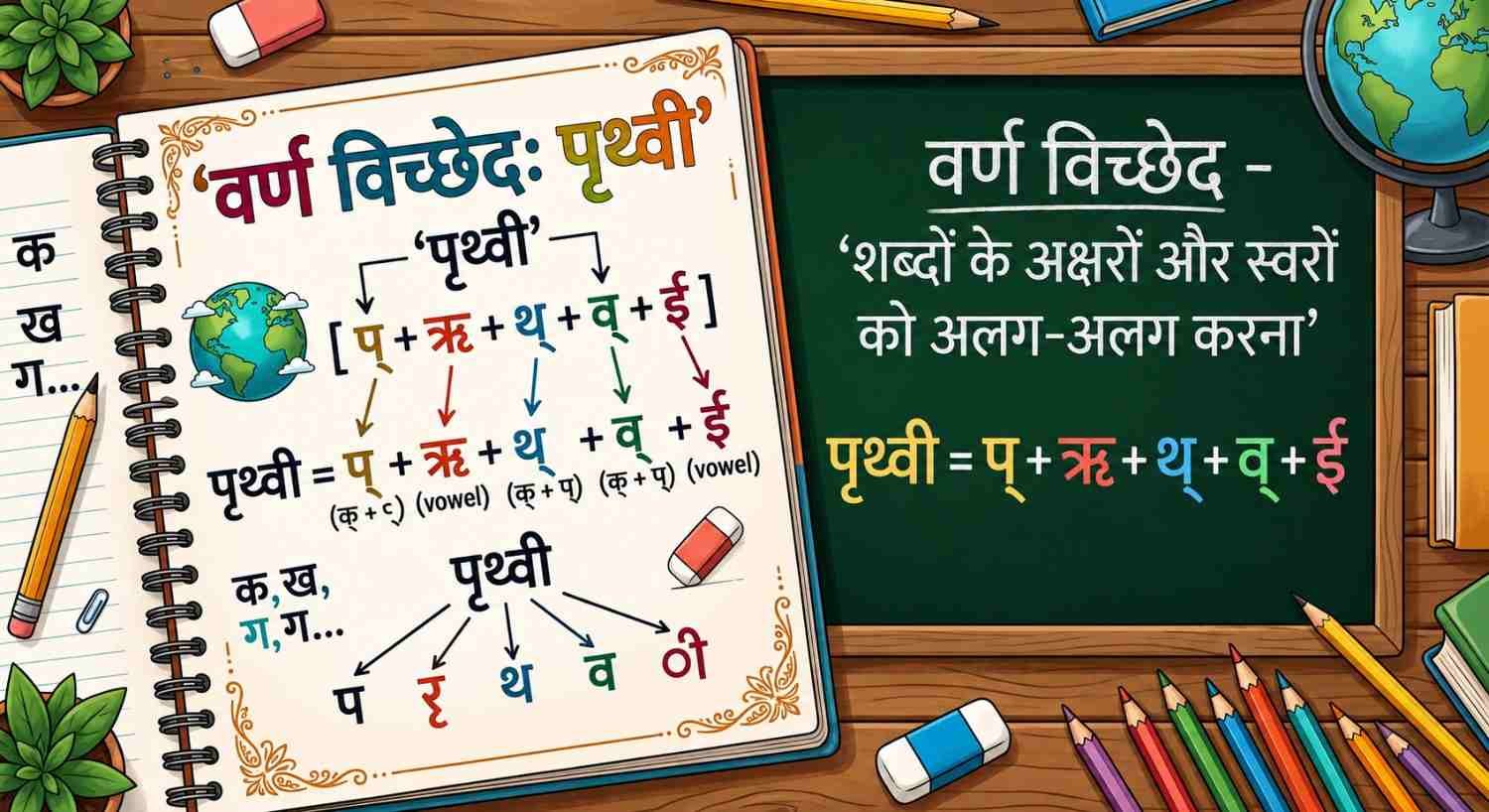
 Akki Yadav