Editorial Team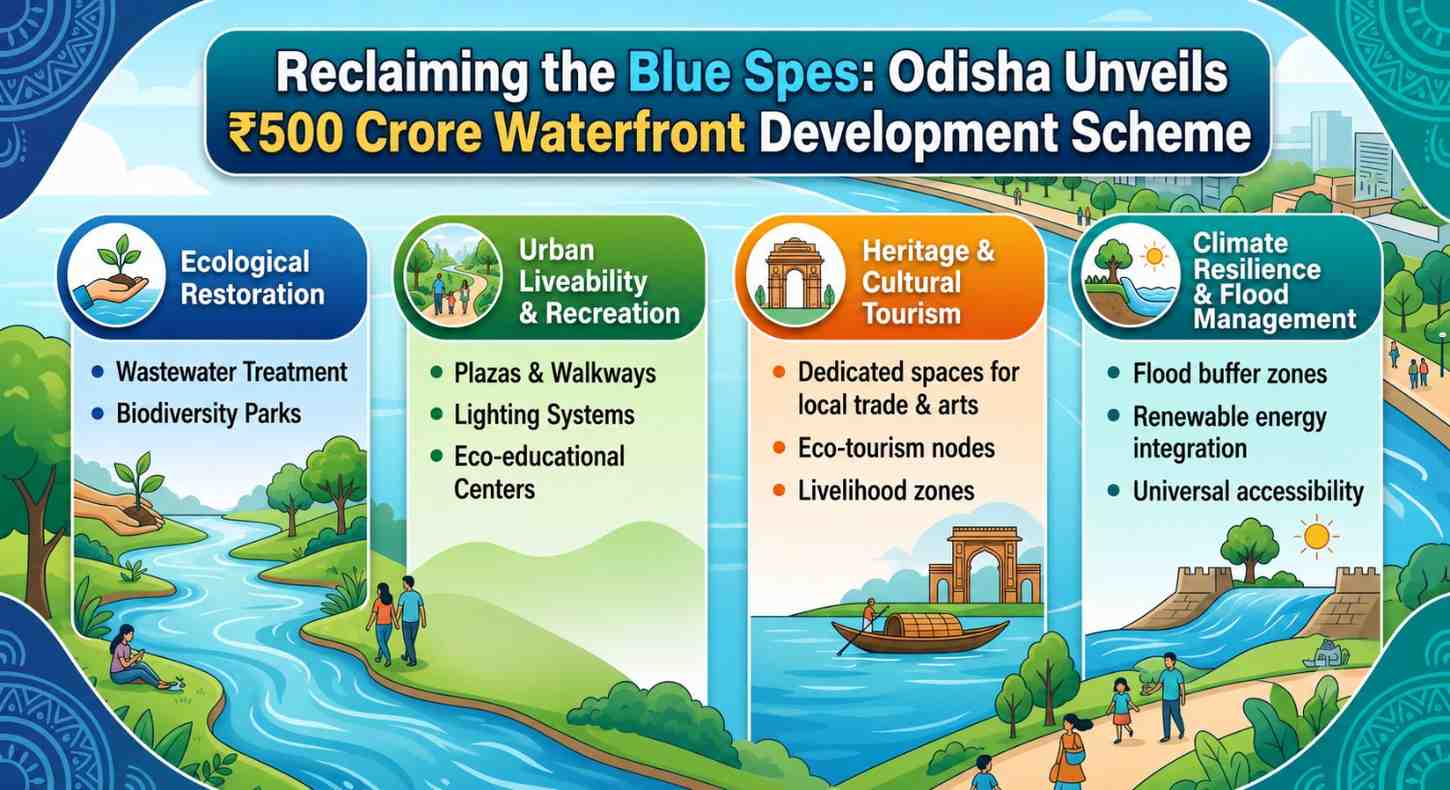
Bhubaneswar — In a major push toward urban rejuvenation and climate resilience, the Government of Odisha has officially launched the Waterfront Development Scheme (Jalatat Bikash Yojana). Approved by the Cabinet chaired by Chief Minister Mohan Charan Majhi, the initiative allocates an outlay of ₹500 crore over five years to restore neglected riverbanks, floodplains, and urban water bodies across key cities into vibrant, sustainable public spaces.
Implemented by the Housing and Urban Development (H&UD) Department, the project seeks to shift urban planning focus back toward the state’s natural water networks.
Key Focus Areas & Model Projects
The scheme spans major urban centers, with initial priority given to high-impact ecological corridors and culturally significant riverfronts:
- Cuttack & Sambalpur (Mahanadi Riverfronts): Interventions will integrate structured public spaces with local heritage. Cuttack’s stretch will cater to major cultural events and trade history, while Sambalpur’s development will highlight Sambalpuri cultural tourism.
- Bhubaneswar (Daya-Gangua Corridor & Kuakhai Floodplain): Planned as a “green-blue urban spine,” focusing on large-scale ecological restoration and sustainable public amenities.
- Rourkela (Veda Vyasa along Brahmani River): Aimed at elevating public liveability, recreational zones, and riverbank stabilization.
- Baripada (Budhabalanga) & Chandbali (Baitarani): Tailored around eco-tourism, local culture, and community gathering spaces.
Core Pillars of the Initiative
₹500 Cr Waterfront Development Scheme: Core Pillars
| Pillar | Key Focus Areas & Features |
| Ecological Restoration | • Wastewater treatment • Biodiversity parks |
| Urban Liveability & Recreation | • Plazas & walkways • Lighting systems • Eco-educational centers |
| Heritage & Cultural Tourism | • Dedicated spaces for local trade & arts • Eco-tourism nodes • Livelihood zones |
| Climate Resilience & Flood Management | • Flood buffer zones • Renewable energy integration • Universal accessibility |
The scheme blends physical infrastructure with environmental management:
- Environmental Safeguards: In-situ wastewater treatment plants (such as the newly approved STP at the Daya–Gangua confluence), bio-remediation, and flood-buffer zones to clean natural water flows.
- Inclusive Public Spaces: Pedestrian promenades, child-friendly parks, universal accessibility features, and vendor-inclusive livelihood zones.
- Heritage Integration: Preserving historical connection points along rivers to promote local art, traditional practices, and regional tourism.
Why It Matters
Urban water bodies across India have long suffered from encroached banks, uncontrolled effluent discharge, and siltation. By committing multi-year funding, Odisha joins a growing movement of states treating urban rivers as vital civic and ecological assets rather than hidden backwaters. Beyond aesthetics, well-designed waterfronts reduce local urban heat-island effects, manage monsoon run-off, and bolster local economies through sustainable tourism.


 Akki Yadav